Free template · Excel and PDF
Site diary template, and what to write in it
The site diary is the timeline everyone goes back to when a dispute starts. Get a free template, see an example entry, and learn what makes a diary hold up months later.
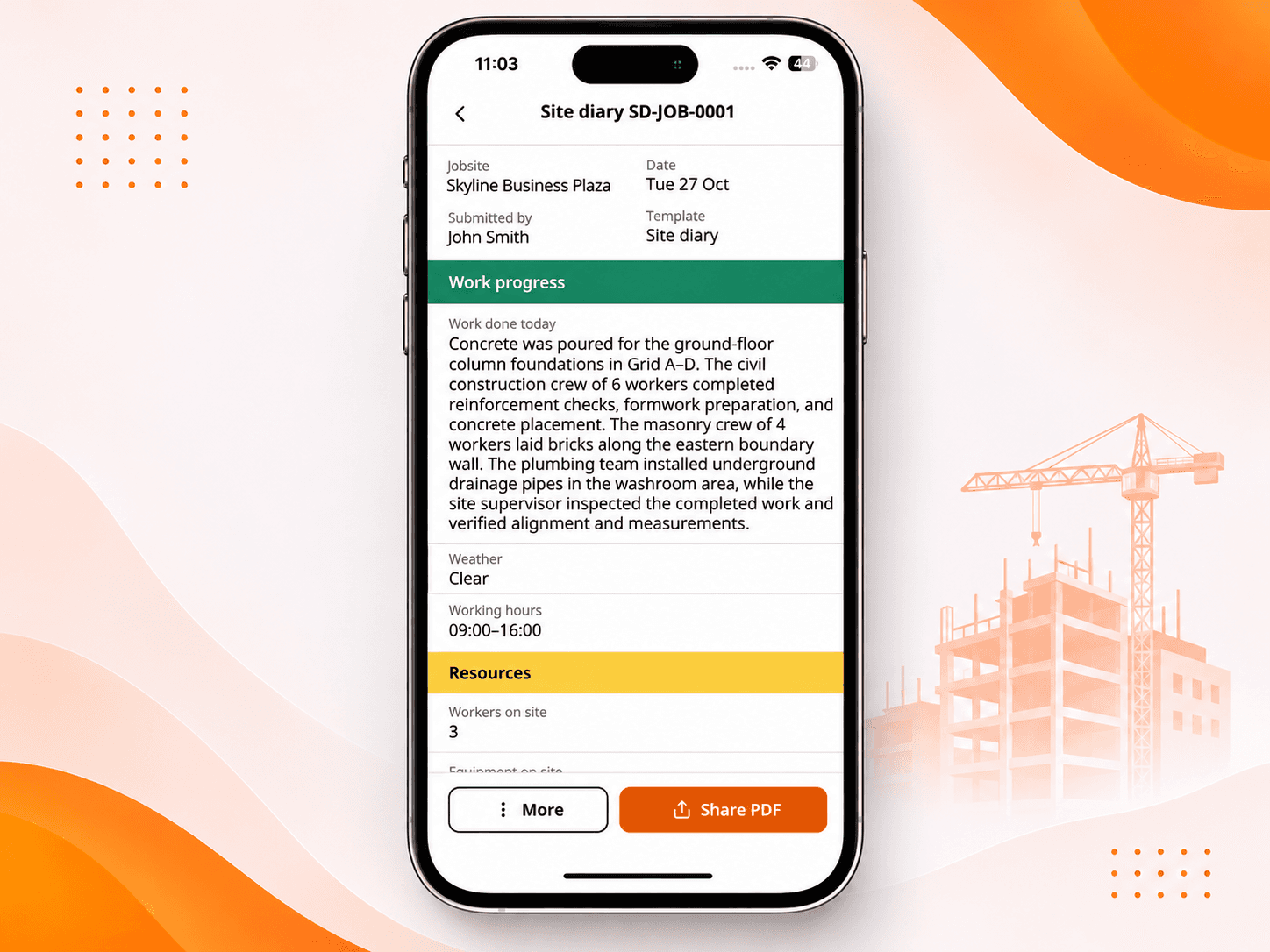
What to record every day
A good diary answers who, what, when and why for one day on site. These are the entries that matter most when the record is read by someone who was not there.
Date, times and weather
Start and finish times, and weather that affected work.
Who was on site
Your team, subcontractors and visitors — client, consultant, authority.
Work carried out
By area and trade, including work by utilities and other third parties.
Instructions received
Verbal instructions, who gave them, and when. Confirm them in writing.
Materials, plant and equipment
What arrived, what was used, what broke down.
Delays, accidents and complaints
What happened, the cause, and what was done about it.
Based on Aphex, Construction site diary and Diales, contemporary records.
An example entry
[Date] · 07:00–17:30 · Clear, 41°C. Midday break observed 12:30–15:00.
On site: 38 own staff; [Subcontractor] MEP 12; consultant's inspector 10:15–11:00.
Work: Blockwork level 4, zones B–C. Level 3 slab rebar fixing 60% complete.
Instruction: Consultant verbally asked to hold level 3 pour until revised drawing issued. Confirmation requested by email 11:20.
Delay: Tower crane down 14:00–16:30 (hydraulic fault). 2.5 hrs lost on rebar lifting.
Illustrative entry. Names and details are placeholders.
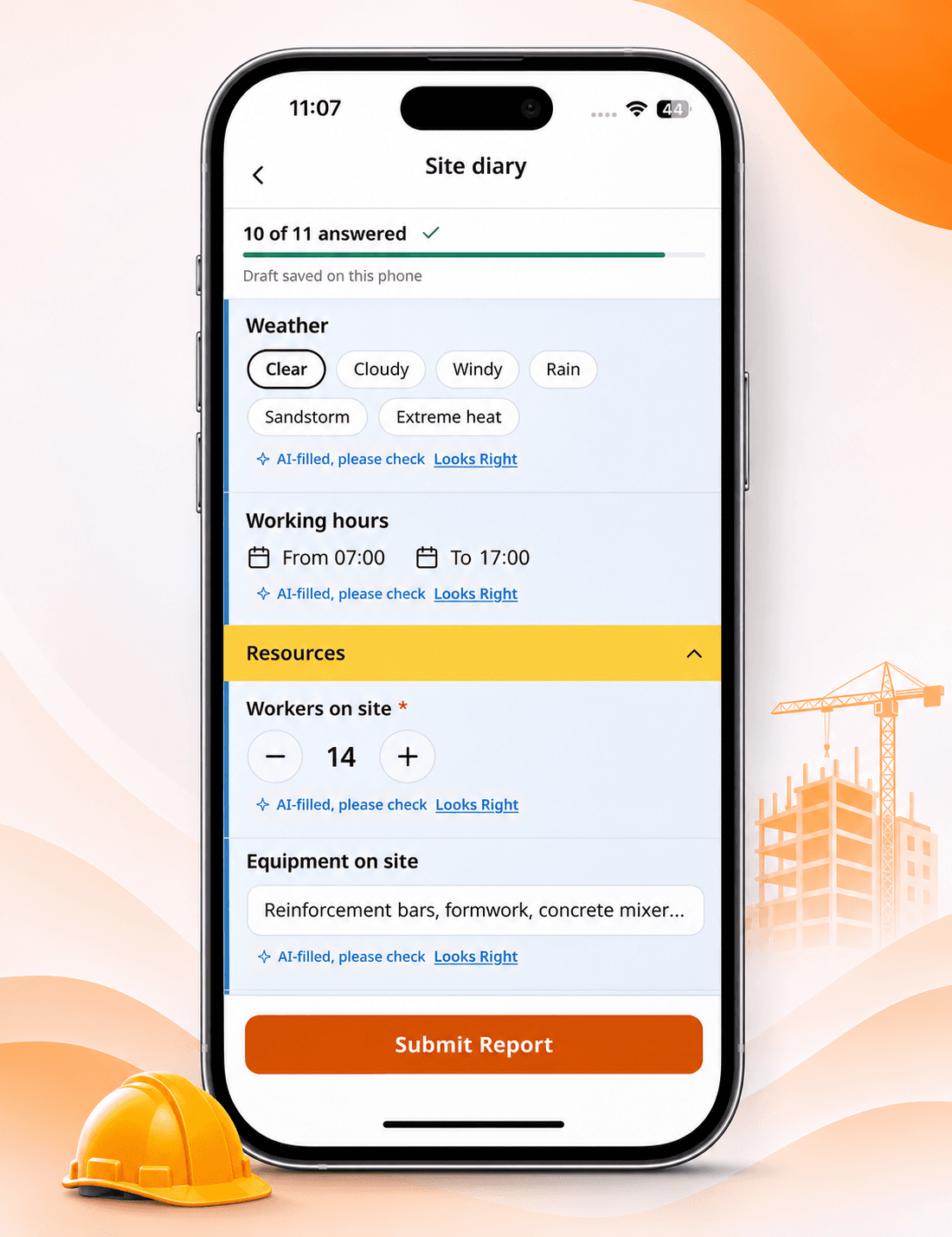
No more paper diaries
Speak the entry. daftar writes the diary.
Supervisors record a voice note in their own language. daftar turns it into a diary entry, adds the day's photos, and files it by site and date — signed on site, kept for the life of the project.
The complete guide
Seven rules for a site diary that holds up
A site diary is read most carefully by people who weren't on site — a claims consultant, an adjudicator, a new project manager. Contemporary records, made at the time of the event, carry the most weight when time or money is argued (Diales). These rules keep yours worth reading.
- Write it every working day, the same day. Gaps raise questions. An entry written a week later looks like it was written for the dispute.
- One named person keeps it. Consistency matters more than style. Name a deputy for leave days.
- Facts, not opinions. “Consultant did not attend 10:00 inspection; called 10:25, no answer” — not “consultant unreliable again”.
- Times on everything. When the instruction was given, when the delivery arrived, when work stopped and restarted.
- Never erase. On paper, strike through and initial. Digitally, keep the edit history.
- Confirm verbal instructions in writing. Record who said what, then send written confirmation the same day and note that you did.
- Sign it and attach the photos. A dated, located photo turns an entry from a claim into evidence.
Weak entry vs strong entry
| Weak | Strong |
|---|---|
| Client visited | Client's representative [Name] on site 11:00–11:45, walked level 3, asked to relocate DB-3A 1.2 m east (verbal). Confirmed by email 12:10. |
| Bad weather | Sandstorm 13:30–15:15, visibility poor, tower crane stopped per lift plan, 2 lifts deferred to next day. |
| MEP sub short staffed | [Subcontractor] MEP 6 on site against 14 in agreed resource plan; level 2 first fix behind; notified their PM by letter ref. [ref]. |
| Water leak | Leak from temporary water line, basement grid B4, found 07:20, isolated 07:35, 2 photos attached; no damage to installed works. |
When the diary gets read
You write it every day; it's read on the few days that matter most:
- Extension-of-time claims — to prove what delayed you and for how long.
- Payment disputes — to show work was done and instructions were given.
- Back-charges to subcontractors — to show who was on site and who wasn't.
- Accident investigations — to show what was happening, who was there, and what briefings were given.
- Defect claims after handover — to show how and when work was done and inspected.
Keeping diaries across many sites
With ten sites, you have ten diary styles — unless everyone uses the same template. Fix the sections, make the key fields required, and review a sample each week from head office. In daftar every site uses the same form, entries are filed by site and date, and you can search all of them at once.
Questions
Who should keep the site diary?
Usually the site manager or site engineer, every working day. One named person keeps it consistent.
Is a digital site diary accepted as evidence?
What matters is that the record was made at the time and wasn't changed later. daftar stamps each entry and photo with time and place, and every PDF carries a QR code to check it.
Site diary vs daily progress report?
The diary records events and instructions; the daily progress report measures progress against plan.
Do we still need a bound paper diary?
Only if your contract or client requires one. Otherwise a digital diary with time stamps, signatures and an edit history is easier to keep complete and much easier to search.
Can supervisors write in their own language?
In daftar, yes. They write or speak in their language, and the office reads it in theirs — translate into your local language with one tap.
What if we missed a day?
Write a late entry, mark it clearly as late with today's date, and say what it's based on. Never backdate.
How long should we keep site diaries?
For the project, its defects liability period, and as long as any claim could arise. daftar keeps them for the life of the project, and you can export them whenever you want.
Bring the site and the office back together
Apps for iPhone and Android, and a web dashboard for the office.