Free template · WIR and MIR
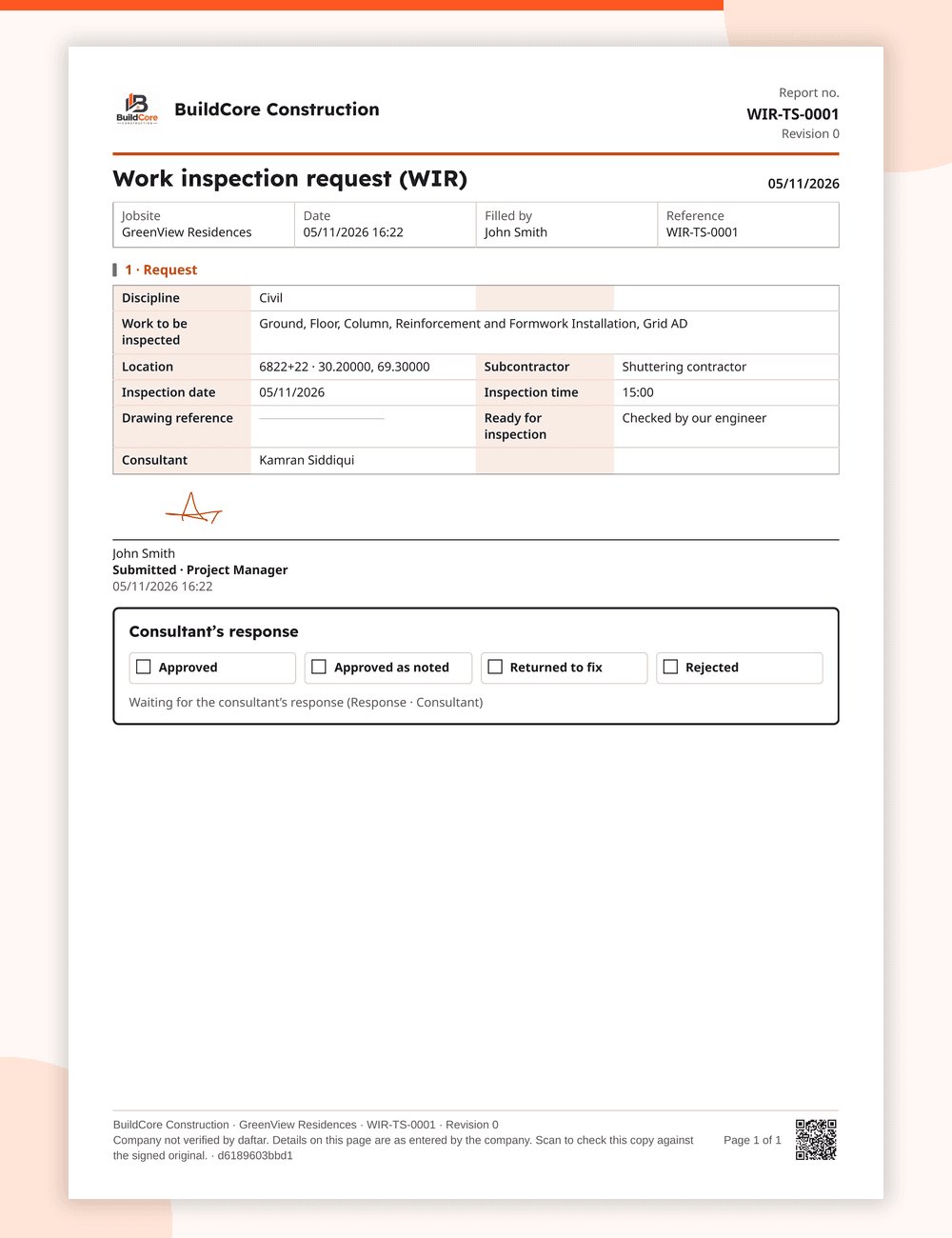
Work inspection request (WIR) template
The quality gate between your site team and the consultant. Download a WIR with every field consultants expect, and see the inspection process step by step.
The inspection process in 8 steps
- 01
Finish the activity
To approved drawings, specification and method statement.
- 02
Inspect it yourself
Your own QA/QC check before the consultant comes.
- 03
Prepare the WIR
References, checklist, photos and test results attached.
- 04
Submit with notice
Respect the notice period your quality procedure sets.
- 05
Joint inspection
The consultant checks the location against acceptance criteria.
- 06
Decision recorded
Approved, approved with comments, rejected, or not ready.
- 07
Correct and resubmit
Show what changed, referencing the previous WIR.
- 08
Keep the approved record
It's your proof the work was accepted.
Process based on PlanRadar, Work inspection request.
Fields in the template
- Project and WIR number
- Discipline or work package
- Activity description
- Exact location (building, floor, grid)
- Contractor and subcontractor
- Requested date and time
- Drawing and specification refs
- Method statement ref
- Inspection and test plan ref
- Completed checklist
- Material approval refs
- Site photos
- Test results or certificates
- Previous WIR (resubmissions)
- Decision and signatures
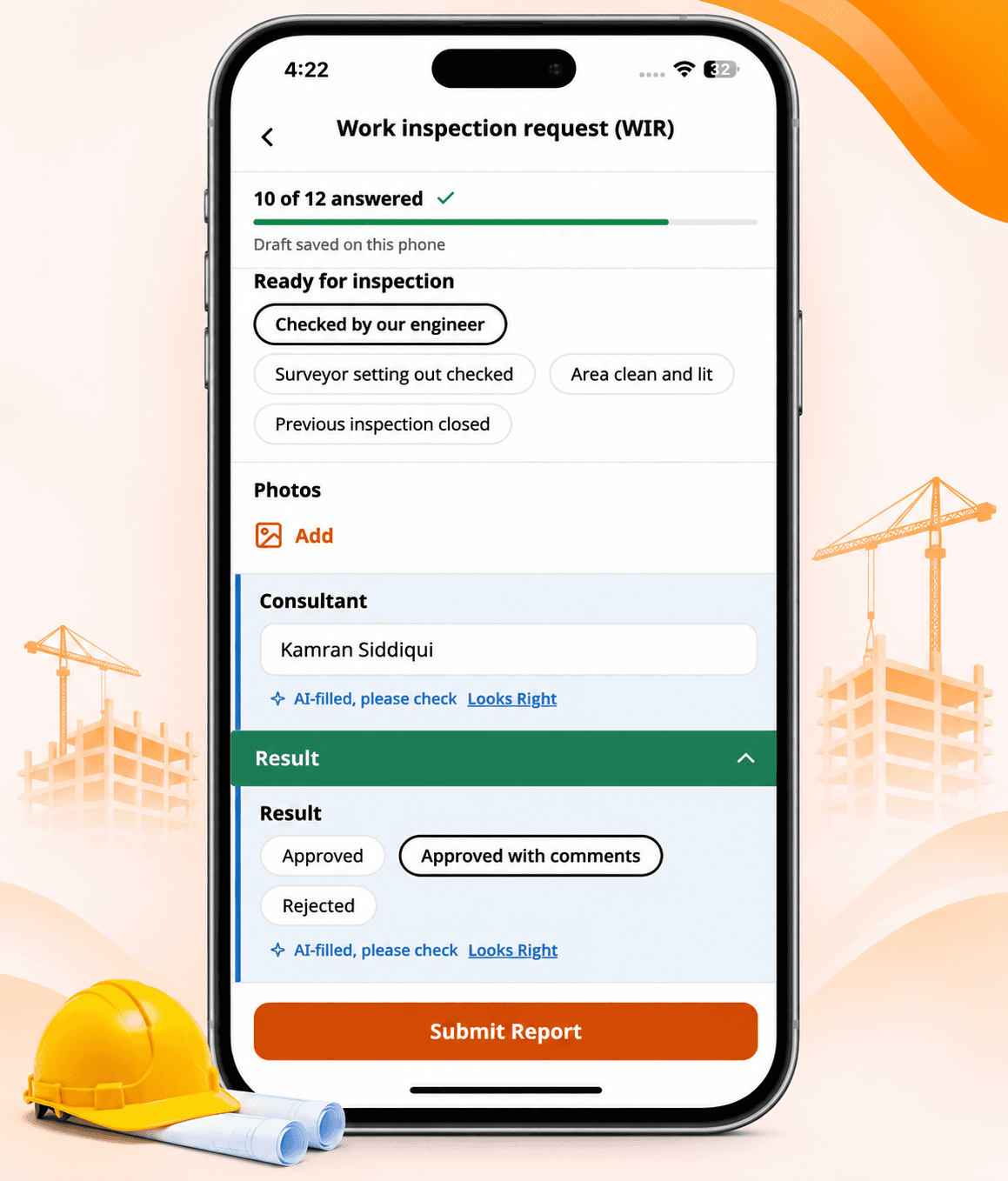
Inspections in daftar
Raise it on site. The consultant decides on the phone.
Invite the consultant as a guest — free, and limited to the conversations you choose. They inspect, approve or reject with comments and photos, and the signed WIR files itself under the site.
The complete guide
Getting WIRs approved the first time
Every rejected WIR costs a day: a team on standby, a pour moved, a consultant visit rebooked. Most rejections are avoidable.
Hold points and witness points
Your inspection and test plan (ITP) marks which inspections stop the work and which don't:
- Hold point — work cannot continue until the consultant or engineer inspects and releases it. Pre-pour rebar checks are the classic example.
- Witness point — the consultant may attend and observe, but work can continue.
Definitions: Aconex, Hold point / witness point.
Put the ITP reference and the point type on every WIR. It tells the consultant how urgent the inspection is, and protects you if a hold point isn't attended on time.
Seven reasons WIRs get rejected
- Work not ready — the inspector arrives and the team is still working.
- No internal inspection — the checklist is blank or signed without checking.
- Wrong drawing revision — built to Rev B when Rev C was issued.
- Material not approved — no MIR or material submittal approval for what's installed.
- Location unclear — “level 3” instead of building, level, zone and grid.
- Test results missing — pressure test, compaction or cube results not attached.
- Short notice — submitted inside the agreed notice period.
Typical WIRs by stage
| Stage | Common inspections |
|---|---|
| Substructure | Excavation level, blinding, waterproofing, foundation rebar, pre-pour |
| Superstructure | Formwork, column and slab rebar, embedded sleeves, pre-pour, blockwork |
| MEP | First-fix conduits, pipe pressure tests, duct leakage, insulation, cable tray |
| Finishes | Plaster, screed levels, waterproofing flood test, tiling, false ceiling, painting |
| External works | Sub-base compaction, kerbs, asphalt layers, drainage, landscaping |
Keep a WIR register
One line per WIR: number, date submitted, activity, location, ITP point type, inspection date, decision, and closed date. Number them so they sort and search, for example [project]-WIR-[discipline]-[running number]. The register shows at a glance what's waiting on the consultant — useful evidence when inspections are attended late. In daftar, every WIR is filed under its site automatically, so finding one takes seconds.
Questions
What's the difference between a WIR and an MIR?
A WIR asks for inspection of finished work. An MIR asks for inspection of materials delivered to site before they're used.
How much notice does the consultant need?
Your project's quality procedure sets it. Put the agreed notice period on the WIR form so nobody argues later.
What if the work is rejected?
Fix it, then resubmit with the previous WIR number and evidence of the correction. Raise a non-conformance report (NCR) if the issue is systemic.
WIR or RFI — which do I need?
A WIR asks for an inspection of finished work. An RFI asks a question about the design or the contract, such as a clash between drawings. They often link: an RFI answer changes the work, and the next WIR references it.
Can a consultant approve verbally?
Treat a verbal approval as a site diary entry, not an approval. Get the decision signed on the WIR before you cover up the work.
What if the consultant doesn't turn up?
Record it with the time in your site diary and daily report, notify in writing, and follow the procedure in your contract. Don't cover a hold point without a release.
Bring the site and the office back together
Apps for iPhone and Android, and a web dashboard for the office.